











참여/소식


국유정담
[2017.10] Festival of Korean Intangible Cultural Heritage 2017
작성자 : 관리자
작성일 : 2017-09-29
조회수 : 1471
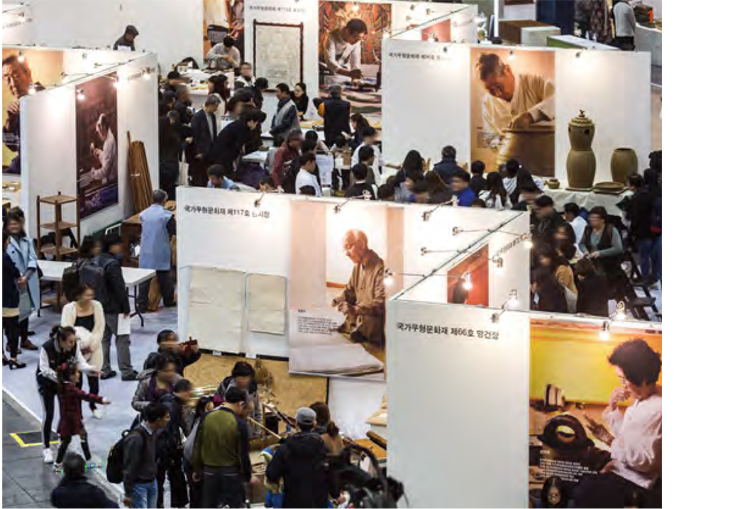
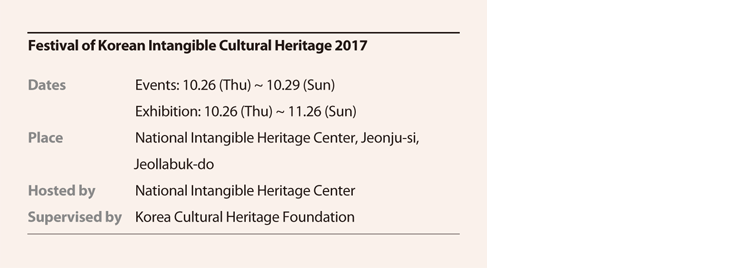
The Grand Festival of Korean Intangible Cultural Heritage will open for the second time this year, with even better themes and exhibitions. It will be your only chance to see those holding the skills of our national intangible cultural heritage. The main 'Festival of Korean Intangible Cultural Heritage 2017' event will be held during four days, from October 26 to 29, at the National Intangible Heritage Center and the area surrounding Hanok Village. Following this, the exhibition will continue until November 26.

Festival of Korean Intangible Cultural Heritage 2017 will be held with the theme of ‘Generation after Generation代代孫孫’ in order to focus on the fact that our intangible cultural property is not cut off from the present, but is always with us. The event will create the opportunity for the public to understand the excellence of the intangible cultural property that has been passed down from the past, the importance of maintaining it and developing it creatively, and to share the stories of ‘Old Today.’
The event will be mainly divided into four sections featuring:
Art, Skills, Experiences, and a Forum. In the Art Area, there will be performances jointly created by graduates along with members of the Intangible Cultural Heritage of Humanity. In the Skill Area, there will be a Themed Hall, the National ntangible Cultural Property Hall, a hall dedicated to the winners of the Traditional Handicraft Art Exhibition, and a Cooperation Hall. The Experience Area is an especially unique part of the festival. Here, there will be a simulation hall, where the public can experience traditional craft events and food, making the event even more enjoyable than lastyear’s exhibition.
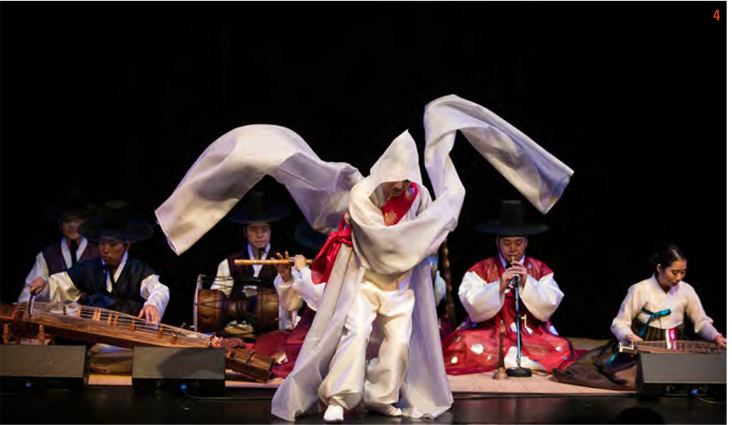
Art (Performance) Area Graduates Joint Performance
The graduates are the witnesses that prove the excellence of our national cultural properties, and they are the treasures that will develop our music in the future. These performances featuring instruments and songs, as well as folk art and plays, will show visitors the essence of the Korean traditional arts that have been passed down generation after generation. You will also have a chance to enjoy the traditional performances of today through a joint performance with a young sorikkun star, or with a traditional singer and the indie band Crying Nut. The Intangible Cultural Property of Jeollabuk-do Joint Performance As with arts and crafts, the performing arts have also developed in a way that reflects different regional characteristics. We will look at the different aspects of the intangible cultural properties of the Jeollabuk-do area in the performing arts through some twenty performances at Jeollabuk-do, where the event is being held, including displays of Simcheongga, Chunhyangga, Jeokbyeokga, etc., by the performers.
Intangible Cultural Heritage of Humanity Joint Performance
The Intangible Cultural Heritage of Humanity is the cultural heritage that was designated by UNESCO to be protected for the future of humanity. Korea has a total of 19 traditions that have been included in the Intangible Cultural Heritage of
Humanity, the third largest number in the world. This performance is focused on ganggangsulae, Jeju Chilmeoridang Yeongdeunggut, Taekkyeon, Arirang, and nongak offered by the practitioners of the intangible cultural heritage of humanity and by the graduates.
Nongak Festival
A total of six nongak have been designated as national intangible cultural property. These dances have been passed down with beats and movements that differ by region. They show the fun-loving character of the Korean people, as well as many regional characteristics. Their designation as an intangible cultural heritage of humanity by UNESCO in the early years of the program gave a sense of pride to Koreans.
The fun Nongak Festival is performed with various percussion instruments such as kkwaenggwari, jing, janggu, and
drums, and it will be the grand finale of Festival of Korean Intangible Cultural Heritage.
National Intangible Cultural Property for Urgent Protection
Some intangible cultural properties have very few practicing apprentices or trainees, so that it is hard to maintain their existence. These have been designated as ‘National Intangible Cultural Property’ by the Cultural Heritage Administration to support various ways of preventing their discontinuance. The most important thing is to create opportunities for them to be performed and to make them active once again. Included in the urgent protection performances will be: baltal (foot mask) featuring a performer with masks on his feet and a comedian; and jultagi (tightrope act) where a performer entertains the audience accompanied by music on a tightrope.
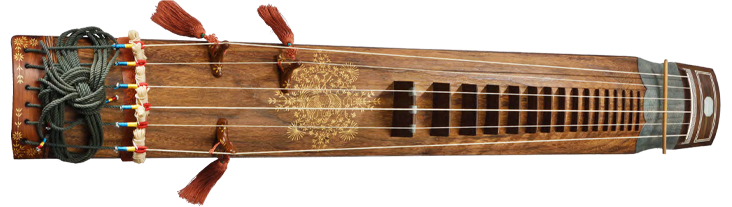
Skills (Exhibition) Area
Themed Hall
The Themed Hall will introduce various performances featuring things such as jongmyojeryeak (music for royal ancestral rites), gannil (horsehair hat making), namsadang nori (an all-male performance), and Eunsan Byeolsinje (a village ritual), accompanied by videos, art works, and graphics focused on the theme of ‘Generation after Generation’ for Festival of Korean ICH.
National Intangible Cultural Property Hall
This is a yearly exhibition that introduces the genealogy of the national intangible cultural property and supports the practitioners of these arts. The exhibition will include more than 250 works by one hundred practitioners of 51 properties from No. 4 ‘gannil horsehair hat making’ to No. 128 ‘seonjajangfan making.’
Exhibition Hall for the Winners of the Traditional Handicraft Art Exhibition
The traditional handicraft art exhibition is a traditional exhibition that started in 1973 in order to preserve traditional handicraft and art techniques and pass them down to a new generation. It also features a contest to discover the most excellent traditional craftsmen. In the hall with the display of the winners’ works, there is also a selection of Presidential Prize winners to offer visitors the opportunity to look back through the history of the exhibition.
Cooperation Hall
In the Cooperation Hall, products are displayed that were developed jointly by traditional master craftsmen and designers for use in life today. These works feature popular, practical designs that use the materials or the methods of traditional crafting, and provide the possibility of incorporating traditional art in modern life, as well as suggesting ways to create highly valued items.
Certification Hall
The Korea Cultural Heritage Foundation gives certification marks to selected works and products of the master craftsmen, in order to maintain the quality of this work and its traditions. The exhibition will feature the works that have received a certificate this year.
Participation (Experience) Area
Opening Event Hall (Simulation Hall)
Here, you can see the process of making crafts and the materials used by the master craftsman in a series of public simulations. Simulation events: somokjang (cabinet making), duseokjang (metal crafting), onggijang (earthenware making), geumsokhwaljajang (metal movable type making), mokjogakjang (wooden sculptures), hanjijang (Korean paper making), gannil (horsehair hat making), mosi (fine ramie) weaving, gungsijang (bow-and-arrow making), manggeonjang (horsehair headband making), tanggeonjang (horsehair hat making), yugijang (brassware making), chimseonjang (needlework)
Intangible Cultural Property Experience Hall
As well as the craft and art performances, experience programs are offered where visitors can take part. There are also various kinds of traditional food available, such as Buddhist cuisine, royal cuisine, etc., and traditional games that have been designated as national and Jeollabuk-do intangible cultural properties.
Experience programs:
[Traditional craft art] Making traditional hand fans, naturally dyed handkerchiefs, and knotted bracelets
[Traditional performance] Taekkyeon, traditional dance, pansori (to be determined)
Lectures by public figures
Famous guests have been invited to deliver speeches related to traditional culture and interesting aspects of history.
Academic Hall (Forum)
International Forum on Intangible Heritage
The ‘World Intangible Heritage Forum’ will be held based on the theme of ‘City and ICH.’ The international forum
will include experts in intangible heritage and the people concerned with its policies, etc. It will create an opportunity
to look for ways to preserve and utilize our intangible cultural heritage, and to find future directions for its development.
Foundation News 1 Written by the Crafts Promotional Team, Korea Cultural Heritage Foundation



